
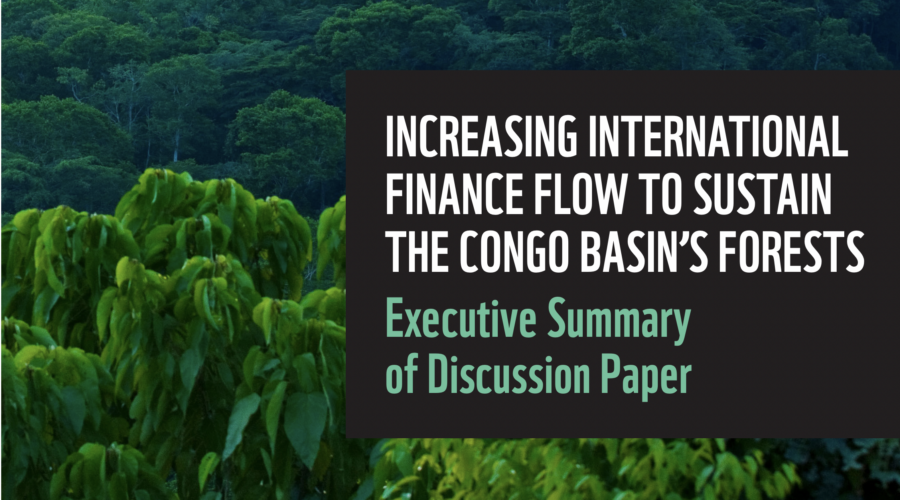
Conserving the forests of the Congo Basin is key to achieving international climate and biodiversity goals. The Congo Basin – formed by Cameroon, the Central African Republic, the Democratic Republic of the Congo, Equatorial Guinea, Gabon, and the Republic of the Congo – hosts the world’s second-largest tropical forest and the largest expanse of high-integrity forests.
Among the three largest tropical rainforests globally, only the Congo Basin has remained a strong net carbon sink, absorbing about 0.61 GtCO2e each year (approximately equivalent to Canada’s total GHG emissions annually).
Although relatively undisturbed compared to other tropical forests, the Congo Basin is at significant risk today, with deforestation and forest degradation increasing quickly. These trends call for protective measures.
Congo Basin countries need to strike a balance between economic growth and natural resources conservation. Additionally, governance and public debt challenges hinder the implementation of regulations or green investments that could protect these forests.
While several efforts to scale up green finance for forest conservation exist, finance has been largely insufficient to date and does not reflect the ecosystem and climate services it provides.
This discussion paper, Increasing International Finance Flow to Sustain the Congo Basin’s Forests, proposes six strategies to mobilize public and private finance for sustainable development and forest conservation tailored to the Congo Basin’s characteristics, needs, and priorities:
- Scaling public finance: Establishing a sustainable forest trust for the Congo Basin.
- Increasing fiscal space in Congo basin countries: Assigning value to the Congo Basin’s natural assets to encourage long-term investments.
- Stimulating investments in conservation: Issuing a forest bond linked to new ecosystem payments.
- De-risking private investment: Enhancing the use of guarantees in the context of climate finance and green growth.
- Investing in pipeline development: Creating an investment and technical assistance facility for environmental markets.
- Attracting foreign direct investment: Establishing environmental markets investment promotion agencies in the countries of the Congo Basin.
Climate Focus developed this discussion paper in collaboration with WWF and the Commission des Forêts d’Afrique Centrale (COMIFAC).
Want to stay up to date on publications from Climate Focus?
Subscribe to our quarterly newsletter to get the latest research.