
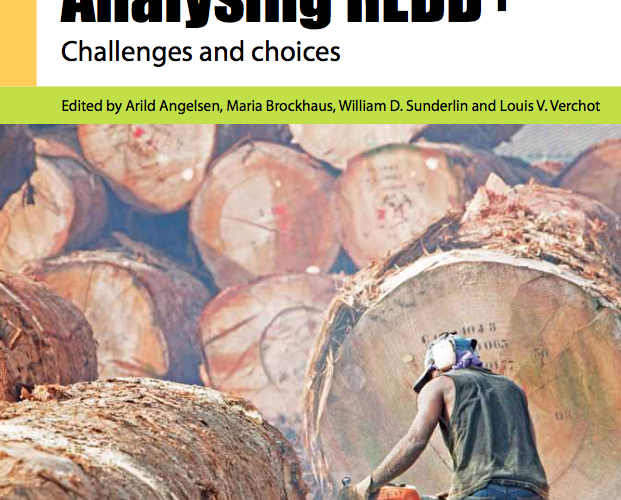
Charlotte Streck co-authored a chapter titled “Financing REDD+” for the newly published third book in a series of highly recognised REDD+ volumes from CIFOR. The book provides an analysis of actual REDD+ design and early implementation, based on a large research project – the Global Comparative Study on REDD+ (GCS), undertaken by CIFOR and partners. It takes stock of national, subnational and local REDD+ experiences, and identifies the political and practical challenges to designing and implementing effective, efficient and equitable REDD+ policies and projects. Key conclusions are:
As an idea, REDD+ is a success story: It is a fresh approach generating hope of significant result-based funding to address an urgent need for climate change mitigation. The idea has been sufficiently broad to serve as a canopy, under which a wide range of actors can grow their own trees.
REDD+ faces huge challenges: Powerful political and economic interests favour continued deforestation and degradation. Implementation must be coordinated across various government levels and agencies; benefits must be distributed and need to balance effectiveness and equity; tenure insecurity and safeguards must be genuinely addressed; and transparent institutions, reliable carbon monitoring and realistic reference levels are all required to support result-based systems.
REDD+ requires – and can catalyse – transformational change: New economic incentives, new information and discourses, new actors and new policy coalitions have the potential to move domestic policies away from the business as usual trajectory.
REDD+ projects are hybrids in high deforestation areas: Project proponents are pursuing strategies that mix the enforcement of regulations and support to alternative livelihoods (ICDP) with result-based incentives (PES). Projects tend to be located in high deforestation and high forest carbon areas, yielding high additionality if they succeed.
‘No regret’ policy options exist: Despite uncertainty about the future of REDD+, stakeholders need to build political support and coalitions for change, invest in adequate information systems, and implement policies that can reduce deforestation and forest degradation, but are desirable regardless of climate objectives.